EU Battery Regulation (EU) 2023/1542: QR Code & Battery Passport Readiness
EU Battery Regulation (EU) 2023/1542: QR Code & Battery Passport Readiness
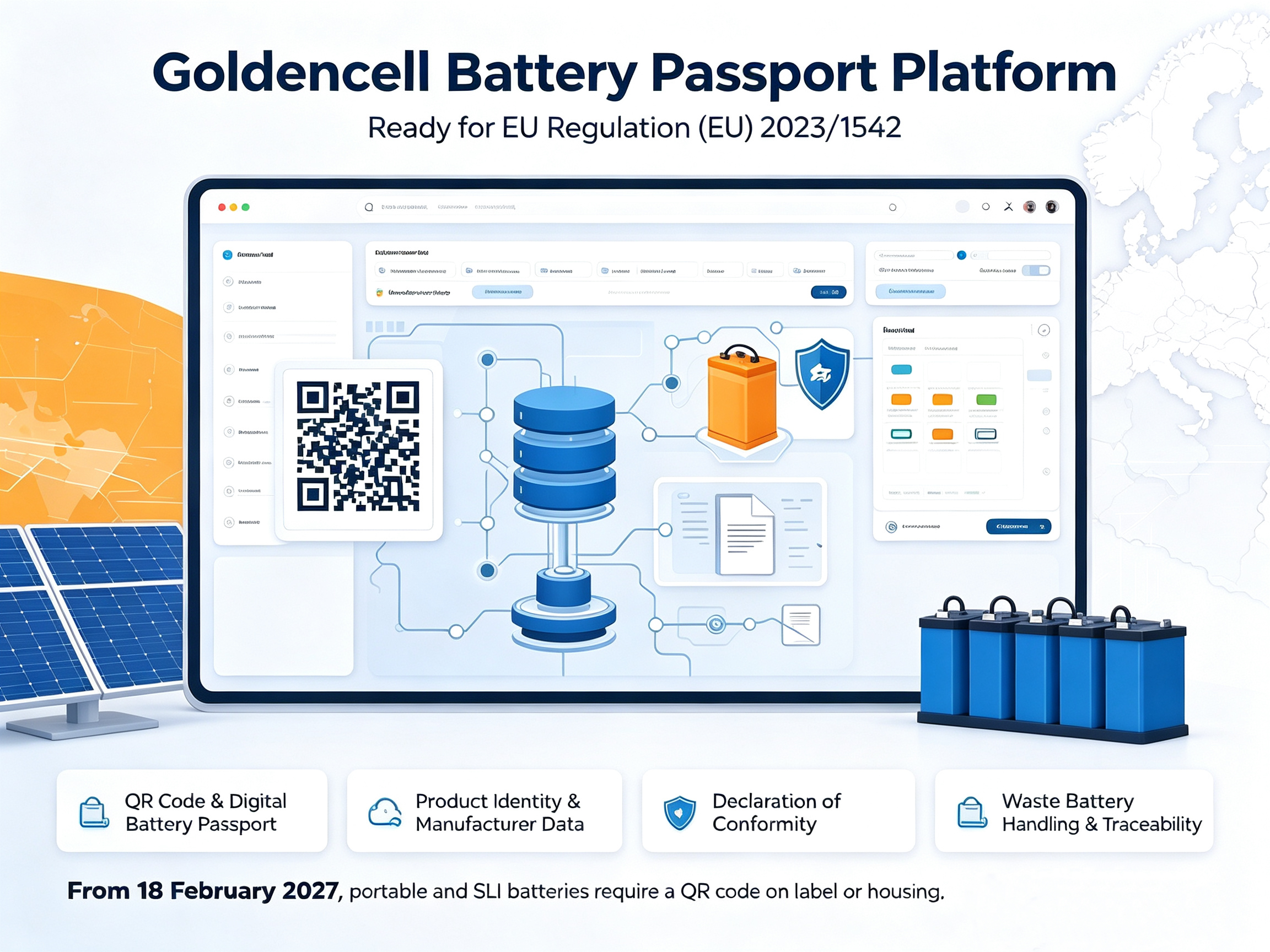
Under the EU Regulation (EU) 2023/1542 concerning batteries and waste batteries, batteries placed on the EU market will need to carry a QR code — linked to product, conformity and end-of-life information, and to the mandatory battery passport where applicable — from 18 February 2027. Goldencell has already built the supporting platform to help our customers prepare.
What the EU regulation requires
Regulation (EU) 2023/1542 replaces the former EU Battery Directive and sets sustainability, labelling and digital-product requirements for all batteries sold into the European Union. From 18 February 2027, batteries covered by the regulation must carry a QR code printed or engraved on the battery itself, or on its label / packaging where the size or nature of the battery does not allow direct marking.
- Portable batteries and SLI (starting, lighting and ignition) batteries: the QR code on the label or battery body links to the required product and compliance information set out by the regulation.
- EV batteries, LMT (light means of transport) batteries and industrial batteries over 2 kWh: the QR code links to the mandatory digital battery passport.
Information accessible through the QR code
Scanning the QR code should lead to verifiable battery information, typically including:
Product Identity:Battery product name, model / type designation, chemistry, capacity and rated voltage.
Manufacturer:Name, registered trade name and contact details of the manufacturer responsible for the battery.
Conformity Declaration:Access to the EU Declaration of Conformity (DoC) and related compliance / technical documentation.
Waste Battery Handling:End-of-life collection, recycling and disposal instructions; the battery must not be discarded with unsorted municipal waste.
Goldencell has already established the platform
As a professional lithium battery manufacturer serving European customers, Goldencell has set up an internal information platform to organise battery identifiers, product data, conformity documents and end-of-life information — the foundation needed to generate regulation-compliant QR codes and, where required, digital battery passports for our packs.
QR code case example

The QR code above is an illustrative sample. When scanned, it resolves to a dedicated battery record that carries the product name, model, manufacturer, conformity declaration and waste-battery handling information required under (EU) 2023/1542.
Each battery or battery pack can be linked to a unique record, keeping product, compliance and lifecycle information traceable across the supply chain.

