The End of Single Use Logistics: How Long Life IoT Batteries Power Circular Container Systems
Introduction: High performance IoT battery technologies are transforming global logistics by enabling circular packaging systems and eliminating severe electronic waste.
The Carbon Problem in Global Supply Chains
Global trade relies heavily on millions of shipping containers, pallets, and intermediate bulk containers. Historically, the logistics industry operated on a linear consumption model. Companies purchased assets, utilized them until they were lost or degraded, and then discarded them. This approach generated immense resource waste and created a massive carbon footprint. Asset misplacement remains a critical issue, with countless containers sitting idle in remote depots or lost entirely within complex transit networks.
The environmental cost of this inefficiency is staggering. Every lost container represents not only financial damage but also the unnecessary carbon emissions required to manufacture a replacement. In recent years, environmental regulations and corporate sustainability goals have pressured supply chain managers to rethink asset utilization. The focus has shifted from simple procurement to rigorous lifecycle management.
To manage assets effectively, companies need visibility. They must know the exact location, condition, and transit history of every container. This requirement birthed the era of smart logistics, where physical containers are equipped with digital tracking devices. However, this digitalization introduced a new environmental challenge: electronic waste. Early generation tracking devices relied on standard commercial batteries with short lifespans. Replacing these batteries every few months across a fleet of thousands of containers proved financially unviable and environmentally irresponsible.
Shifting from Asset Procurement to Asset Management
The transition to a circular economy requires logistics providers to treat packaging and containers as long term investments rather than disposable commodities. Circular container systems dictate that assets are deployed, tracked, recovered, maintained, and redeployed continuously.
Achieving this closed loop requires uninterrupted data streams. Supply chain control towers depend on constant location pings to optimize routes and coordinate recovery logistics. Without reliable tracking, a returnable packaging program quickly devolves into a massive loss of capital. The success of circular logistics is entirely dependent on the hardware attached to the containers, and specifically, the power source keeping that hardware alive.
Digitalizing Physical Assets with Smart Terminals
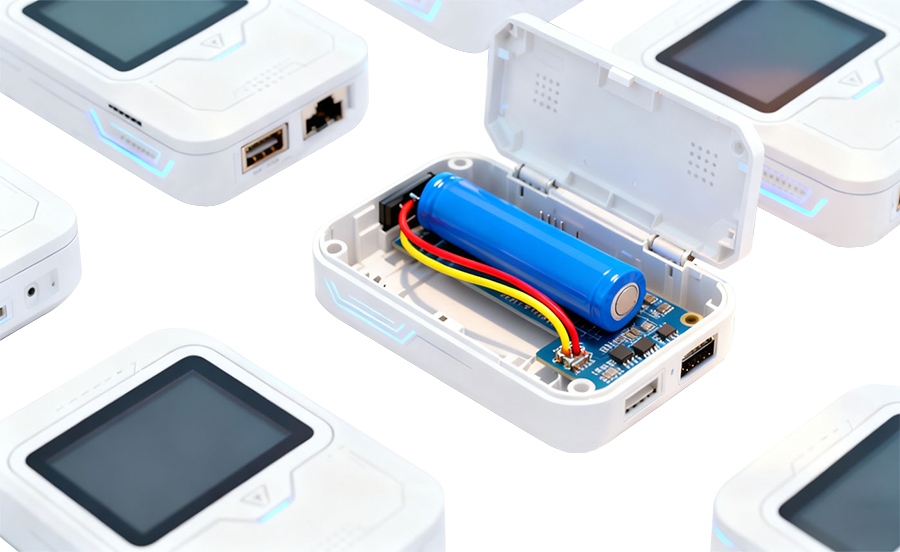
A tracking terminal transforms a dormant steel box into an active node on the global network. These devices integrate GPS modules, cellular modems, satellite communication antennas, and various environmental sensors. They monitor location coordinates, internal temperature, humidity levels, and physical shocks.
Every time a terminal transmits data back to a central server, it requires a significant burst of energy. Cellular transmissions, especially in areas with poor network coverage, demand high pulse currents. Satellite communications require even greater power reserves. The physical environment of global shipping dictates that these terminals must operate entirely untethered. There are no power outlets on a cargo ship deck or a flatbed trailer. Solar panels are frequently rendered useless because containers are stacked tightly together or stored in dark warehouses.
The Bottleneck of Continuous Power
The absolute reliance on internal power makes the battery the most critical component of any IoT tracking solution. If the power source fails, the terminal goes dark, the asset is effectively lost, and the data stream breaks.
Engineers face strict physical constraints when designing these systems. The batteries must be compact enough to fit within discreet tracking enclosures, yet powerful enough to sustain years of daily data transmissions. Furthermore, replacing a battery in the field is a logistical nightmare. Locating a specific container in a sprawling port facility just to swap a power cell negates any cost savings the tracking system might offer. Therefore, the industry requires solutions that can outlast the natural maintenance cycle of the container itself.
The Environmental Ledger of High Performance IoT Power
Addressing the power bottleneck requires advanced electrochemical engineering. Industrial grade IoT tracking battery solutions offer a completely different performance profile compared to consumer electronics. These highly specialized power cells serve as the foundational infrastructure for sustainable asset management.
E Waste Reduction Through Extended Lifespans
The most direct environmental benefit of advanced battery technology is the drastic reduction of electronic waste. Traditional alkaline or standard lithium-ion cells degrade rapidly, often requiring replacement within twelve to eighteen months. In a fleet of fifty thousand containers, this translates to tens of thousands of discarded batteries entering landfills annually. These discarded cells contain heavy metals and volatile chemicals that pose severe risks to soil and groundwater.
High capacity primary lithium batteries, such as Lithium Thionyl Chloride chemistries, offer functional lifespans extending up to ten years. By aligning the battery life with the operational life of the tracking device, manufacturers effectively eliminate field replacements. This extended deployment cycle drastically cuts the volume of chemical waste generated by the logistics sector. According to technical evaluations on IoT tracking battery solutions for modern logistics, minimizing battery replacement is the most effective strategy for lowering the carbon footprint of digital supply chains.
Operational Stability in Extreme Environments
Global shipping routes subject equipment to brutal environmental extremes. A container might experience the freezing temperatures of a northern winter and the intense heat of an equatorial port within a single voyage.
Standard batteries experience severe voltage drops in freezing conditions, leading to unexpected device shutdowns. In high heat, they face the risk of leakage or thermal runaway. High performance IoT batteries are engineered with wide temperature tolerances, typically operating flawlessly between negative forty degrees and positive eighty five degrees Celsius. This thermal stability ensures that tracking devices remain online regardless of geography. As highlighted in discussions regarding the advantages of high cycle IoT battery integration, this reliability prevents blind spots in the supply chain, ensuring assets are continuously monitored and successfully recovered.
Minimal Self Discharge for Maximum Efficiency
All batteries naturally lose power over time, even when not actively powering a device. This phenomenon is known as self discharge. For devices expected to remain in the field for a decade, high self discharge rates are catastrophic.
Advanced IoT power solutions utilize passive chemical layers that prevent internal energy loss, reducing the self discharge rate to less than one percent per year. This high efficiency means that almost all the stored chemical energy is dedicated strictly to transmitting valuable logistics data. It represents the ultimate optimization of resources, ensuring no chemical potential is wasted during long idle periods in storage yards.
Commercial Proof: Economic and Environmental Returns
Logistics executives evaluate technology investments through rigorous total cost of ownership models. The initial unit cost of a high performance battery is higher than a standard commercial cell. However, the economic argument for industrial grade power becomes undeniable when factoring in the total lifecycle.
By eliminating labor costs associated with field maintenance and asset recovery, companies realize a massive return on investment. The ability to maintain a reliable circular packaging loop reduces the need to purchase new containers, directly saving capital expenditure.
Frequently Asked Questions (FAQ)
Why are standard consumer batteries unsuitable for container tracking?
Standard batteries lack the energy density and environmental resilience required for industrial use. They suffer from high self discharge rates and fail rapidly under extreme temperatures, necessitating frequent replacements that create unacceptable maintenance costs and electronic waste.
How does battery life impact the success of returnable packaging?
Returnable packaging relies entirely on visibility. If the tracker dies, the asset is lost in the network. A battery that lasts five to ten years guarantees continuous tracking, enabling companies to confidently retrieve and reuse their assets, thus maintaining the circular loop.
Are these high capacity industrial batteries safe for global transit?
Yes. Leading manufacturers engineer these power sources with rigid safety mechanisms, including hermetic glass to metal seals and integrated PTC thermistors. They are rigorously tested to comply with international maritime and aviation transport regulations, ensuring stability against shock, vibration, and pressure changes.
Towards a Green Supply Chain
The logistics industry is at a pivotal inflection point. The mandate to reduce carbon emissions and eliminate waste requires a fundamental restructuring of how goods are moved and monitored. Digitalization provides the map for this transition, but reliable energy provides the vehicle.By prioritizing lifecycle longevity over short term procurement costs, supply chain operators can drastically reduce their environmental footprint. The transition to fully circular, zero loss asset management is entirely possible today. It requires hardware that is as resilient as the infrastructure it monitors. Through continuous material science innovation, providers like Goldencell are delivering the sustainable power solutions necessary to make the green supply chain a reality.
References
[1] Ellen MacArthur Foundation. The Circular Economy: Definition & Model Explained.https://www.ellenmacarthurfoundation.org/topics/circular-economy-introduction/overview
[2] Environmental Protection Agency (EPA). Electronics Stewardship and Battery Management.https://www.epa.gov/electronics-batteries-management/electronics-basic-information-research-and-initiatives
[3] McKinsey & Company. Supply Chain 4.0: The Next-Generation Digital Supply Chain.https://www.mckinsey.com/capabilities/operations/our-insights/supply-chain-40–the-next-generation-digital-supply-chain
[4] McKinsey & Company. Supply Chain 4.0 in Consumer Goods.https://www.mckinsey.com/industries/consumer-packaged-goods/our-insights/supply-chain-4-0-in-consumer-goods
[5] IBM. What is Supply Chain Sustainability?https://www.ibm.com/think/topics/supply-chain-sustainability
[6] IBM. What Is Sustainable Supply Chain Management?https://www.ibm.com/think/topics/sustainable-supply-chain-management
[7] Forbes. Cover Your Assets: The Rise Of The Super-Intelligent Supply Chain.https://www.forbes.com/sites/insights-inteliot/2018/09/14/cover-your-assets-the-rise-of-the-super-intelligent-supply-chain/
[8] Forbes. IoT And The Supply Chain Revolution.https://www.forbes.com/sites/businessreporter/2020/02/20/iot-and-the-supply-chain-revolution/
[9] Dietershandel. IoT Tracking Battery Solutions for Modern Logistics.https://www.dietershandel.com/2026/04/iot-tracking-battery-solutions-for.html
[10] Industry Savant. Advantages of High Cycle IoT Battery Integration.https://blog.industrysavant.com/2026/04/advantages-of-high-cycle-iot-battery.html